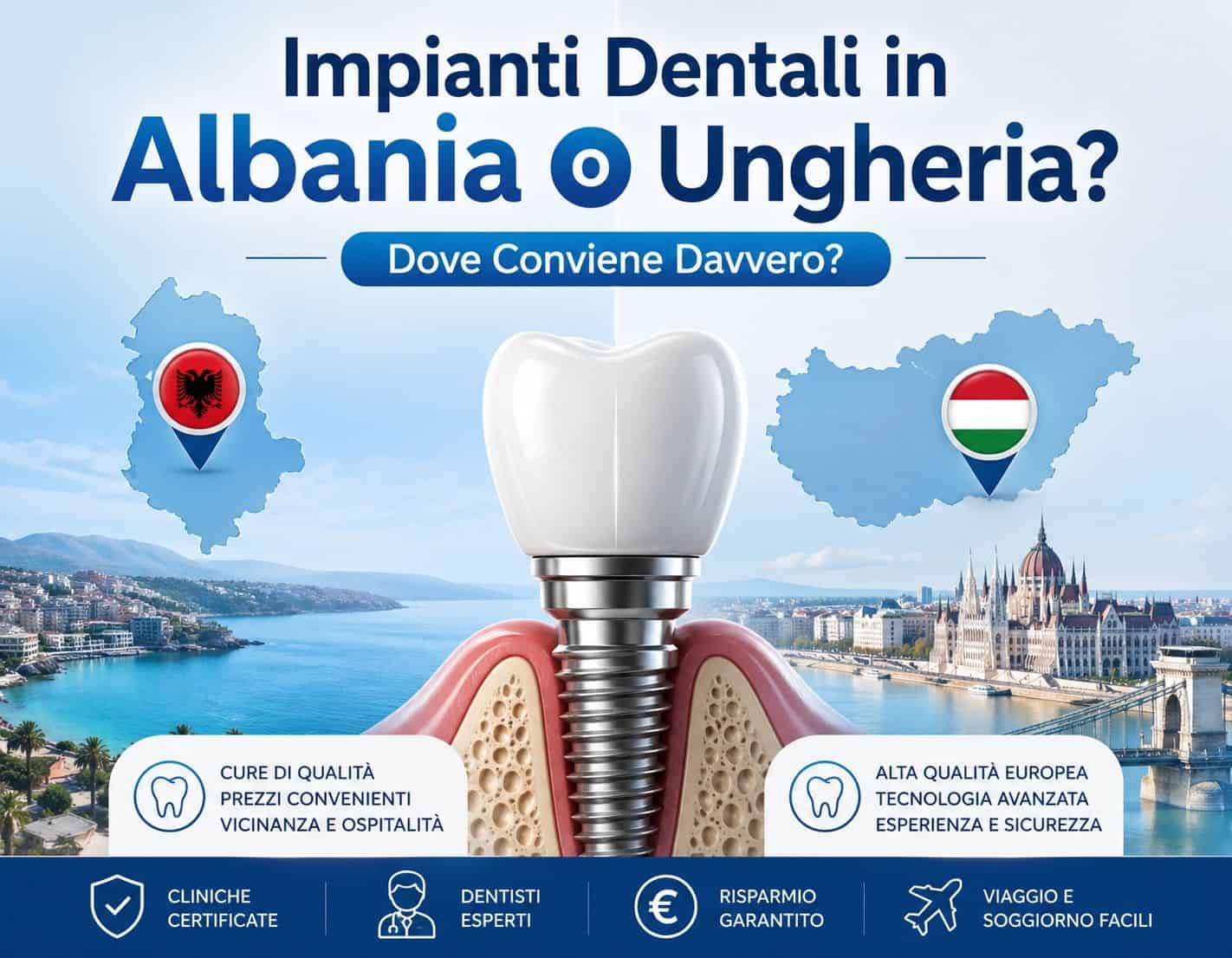
For years, Hungary has been the preferred destination for Europeans seeking affordable dental treatment. Budapest, in particular, has built a solid reputation as the European capital of dental tourism – with dozens of clinics, patients come from Germany, Austria, the UK, and even Italy.
However, something has changed in recent years. More and more Italian patients are comparing Hungary with Albania – and often choose Tirana. Not by chance, and not just for the price.
In this article, we'll offer an honest comparison between the two destinations. Without demonising anyone or exaggerating anything: just the data you need to make an informed decision.

The starting point: both are valid alternatives to Italy
Before entering into a comparison, it's fair to state one thing clearly: both Albania and Hungary offer dental care of a quality superior to what the price might suggest. Both have clinics with European standards, specialists trained at recognised universities, and materials equivalent to those used in the best Italian clinics.
Dental tourism to these destinations is not a risky shortcut – it is a rational choice that thousands of European patients make every year with excellent results.
That being said, there are real differences between the two options. And depending on the patient's specific situation, these differences can make all the difference.
Costs: Albania vs Hungary
Let's start with the aspect that most often guides the initial search.
L’Ungheria è storicamente meno cara dell’Italia — i pazienti che si curano a Budapest risparmiano mediamente tra il 40% e il 60% rispetto ai prezzi italiani per gli stessi trattamenti.
Albania entered this market later, but with a significant competitive advantage. The savings for Italian patients choosing Hygeia Dent in Tirana amount to an average of up to 70% compared to Italian quotes — and in many cases, this saving even exceeds that obtainable in Hungary.
The reason is structural: the cost of living and labour in Albania is lower than in Hungary, where in recent years there has been a general increase in prices, including in the healthcare sector. Budapest remains cheaper than Milan, but the gap with Tirana has widened.
Note: The savings indicated are average estimates based on feedback from our patients and do not constitute official pricing. Each case is assessed individually — contact us for a free, personalised quote.
Logistics: how easy is it to get there from Italy?
This is a factor that many underestimate during the research phase, but which becomes very concrete when you have to organise two trips.
Hungary — Budapest: Well connected to Italy, with direct flights from Milan, Rome, Bologna, Venice, and other cities. Flight prices vary, but accessible fares can be found in the low season. The cost of accommodation in Budapest has increased considerably in recent years — it remains below the levels of Paris or Amsterdam, but it is no longer the budget destination it once was.
Albania — Tirana: Tirana is also well connected to Italy, with direct flights from Rome, Milan, Bari, Bologna, Venice, and Turin. Flight times are often shorter than to Budapest — around 1-1.5 hours from Rome, compared to about 2 hours for Budapest. The cost of accommodation in Tirana is significantly lower than in Budapest, with good quality hotels at very reasonable prices.
For those who have to make two trips – as is the case with implants – this difference in accessory costs is not negligible.
The quality of care: what to truly look for
Quality isn't just measured by looking at a clinic's website. It's measured in terms of staff training, available technologies, protocols applied, and the context in which it operates.
In Hungary there are excellent clinics – but also mediocre ones that exploit the reputation built by the best. The variability is high, and choosing the right clinic requires research.
In Albania, the dental tourism market is more recent and more concentrated. The facilities that have established themselves internationally tend to have more homogeneous standards, partly because they operate in a more competitive context and are driven by the need to build a reputation.
Hygeia Dent operates within Hygeia Hospital — the largest and most modern medical facility in the Balkans. It is not a dental clinic; it is a dental hospital with certified hospital protocols, state-of-the-art diagnostic technologies, and a multidisciplinary team. This level of facility has no direct equivalents within the Hungarian dental tourism landscape, where most offerings are standalone private clinics.
For complex treatments such as -All-on-4 in Albania or -All-on-6 in Albania, having a comprehensive hospital background is not a minor detail – it’s a concrete guarantee of patient safety.
Waiting times
In Hungary – especially in Budapest, where demand is very high – waiting times for an initial appointment can be long. It's not uncommon to wait weeks, sometimes months, before managing to secure a consultation at the most reputable clinics.
In Tirana, waiting times are generally shorter. Hygeia Dent offers the possibility of a free preliminary remote assessment – by sending X-rays, you will receive feedback within a few working days, without having to wait to book an appointment at the clinic. This significantly speeds up the start of the treatment journey.
The point-by-point comparison
| Factor | Albania (Tirana) | Hungary (Budapest) |
| Savings vs Italy | Until 70% | 40-60% circa |
| Flight from Rome | 1-1.5 hours | About 2 hours |
| Accommodation cost | Very low | Medium-high |
| Type of structure | Dental hospital | Private clinics |
| Waiting times | Short | Variables, often long |
| Remote assessment | Yes, free | It depends on the clinic |
| Language | Excellent Italian/English | Mainly English |
| Experience with Italian patients | High and growing | High |
| Geographical location | Southeastern Europe | Central Europe |
Who chooses Hungary and who chooses Albania
There is no universal answer – there are different situations.
Hungary remains a valid choice for those who already have direct contact with a trusted Hungarian clinic, for those located in Central or Eastern European countries where Budapest is geographically more convenient, or for those who prefer a destination with a reputation consolidated over decades.
Albania, and Tirana in particular, is the choice that is emerging strongly for Italian patients. Geographic proximity, lower costs, the quality of available facilities, and growing experience with patients from Italy are making this destination increasingly competitive. It's no coincidence that the flow of Italian patients to Tirana is constantly increasing.

What to look for when choosing a clinic abroad
Regardless of the destination, there are a few things that are always worth checking before entrusting yourself to a foreign establishment.
The training of specialists. Where did they train? Do they have documented experience in advanced implantology? Are the credentials verifiable?
The available technology. Cone beam CT is the standard for implant planning. A clinic that operates without 3D diagnostics is a clinic that operates blind.
The structural context. Is there an anaesthesiology department? How are emergencies managed? Someone operating alone in a small practice does not have the same guarantees as someone operating in a hospital setting.
Communication. Can they explain the treatment plan clearly, in your language, with supporting data? Or is everything vague and generic until you're already there?
The follow-up. Who follows you up during the osseointegration months? Is there a point of contact for the period between the two trips?
On all these points, we invite you to ask us the same questions. Transparency is not optional.
The journey with Hygeia Dent: from consultation to definitive prosthesis
For patients choosing to come to Tirana, the journey with Hygeia Dent is structured to minimise uncertainties.
It begins with a free preliminary remote assessment – your X-rays are analysed by the team and you receive feedback within a few days. If you are eligible, the first trip is planned with all details agreed in advance: dates, treatment plan, costs.
During the first visit, full diagnostics, the procedure, and the application of the temporary prosthesis are carried out. You return to Italy with fixed teeth.
In the following months, the team follows you remotely. When osseointegration is complete, a second trip is planned for the final zirconia prosthesis.
To find out more about how each stage of the implant journey works, you can consult our dedicated page -dental implants in Albania, covering all available solutions — from single implants to complete rehabilitations.

Frequently asked questions
Are Albanian dentists trained the same way as Hungarian dentists?
University education in dentistry in Albania follows European standards. Our specialists have completed training and continuing professional development courses in Europe, with experience in Italian, German and other countries' facilities. The qualification does not depend on the dentist's nationality, but on their training path.
Is Albania safe to travel to?
Tirana is a modern and safe European capital. The level of safety is comparable to many other medium-sized European cities. Thousands of Italian tourists visit it every year – for both dental treatment and traditional tourism.
Can I have assurances about the treatment?
Yes. As with any medical treatment, guarantees concern the quality of execution and the management of any complications according to clinical protocols. The team explains in advance what is covered and how unforeseen situations are managed.
How can I trust a clinic I don't know?
That's the right question. Look for testimonials from real patients, ask to speak to someone who has already gone through the process, and verify the credentials of the specialists. At Hygeia Dent, we are available to answer all these questions before you make any decisions.
What if I prefer Hungary anyway?
It's a legitimate choice. The aim of this article isn't to convince you to choose Albania at all costs — it's to give you the information to make an informed comparison. If, in the end, you prefer Budapest, at least your choice will be a conscious one.