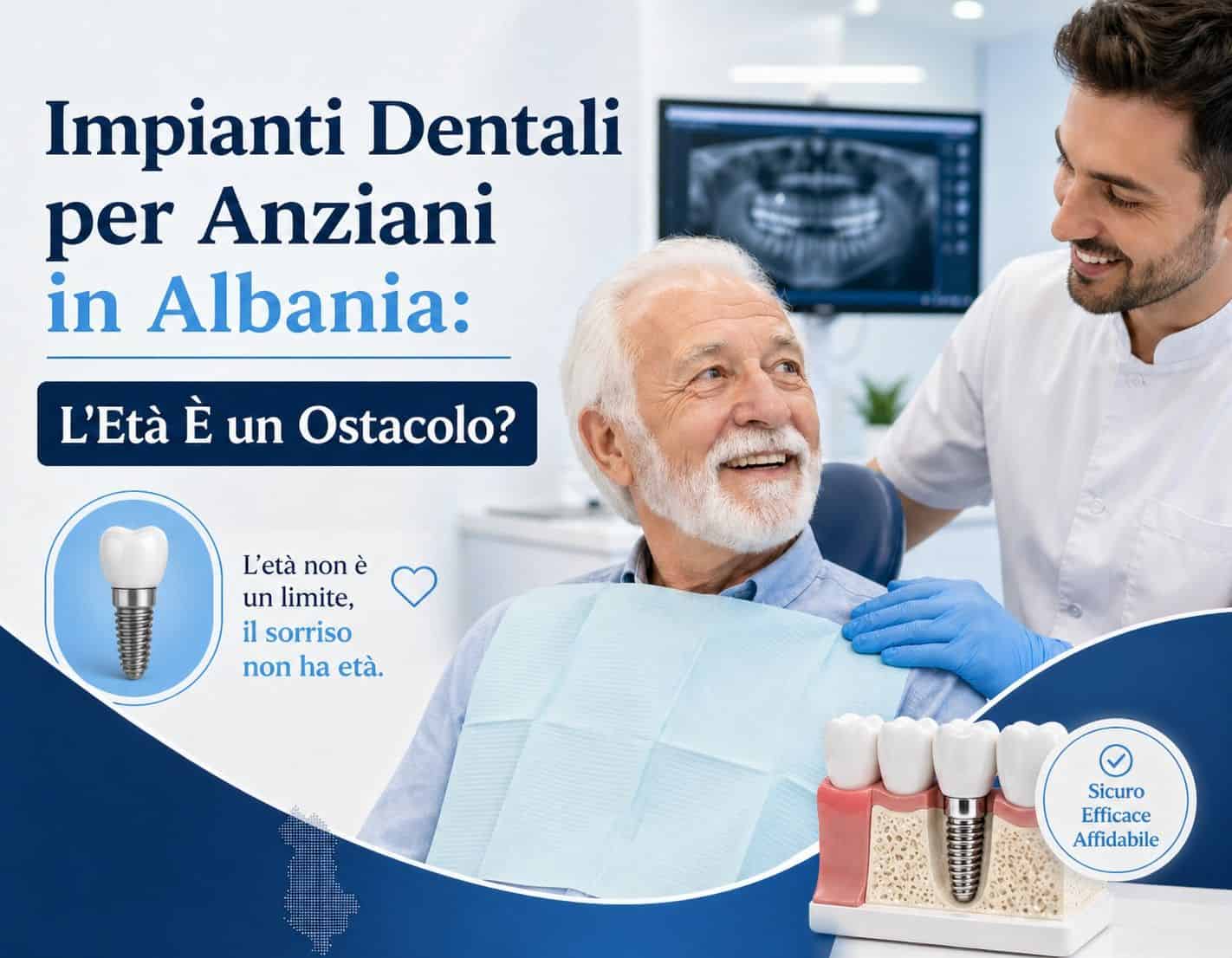
“I'm 72 years old. Can I still get implants?”
It's one of the questions we get asked most often. And the answer – which often surprises – is almost always the same: chronological age alone is not a reason to say no.
And yet, many elderly patients come to us after someone else has told them to give up. Sometimes it's the local dentist, sometimes it's a well-meaning family member, sometimes it's simply the widespread belief that “certain things are no longer done” at a certain age.
That's not the case. And in this article, we explain why – with honesty, no easy promises, and all the necessary clarifications.

What really matters: biological age, not chronological age
The distinction we always make to our patients is this: the age on their identity card isn't what interests us. What interests us is the overall health of the person in front of us.
A 75-year-old patient in good general health, with no relevant systemic conditions and sufficient bone volume, can be an excellent candidate for implants. A 55-year-old patient with uncontrolled diabetes, severe osteoporosis, and a history of heavy smoking might, however, present greater risks.
It's not a matter of years. It's a matter of clinical conditions.
This doesn't mean age is of no consequence – it means it should be assessed in the overall context of the person, not as an isolated factor.
The factors we assess in senior patients
When a patient over 65 contacts us for an assessment, our team analyses a series of specific elements before giving any advice.
Bone density
As age advances, bone tends to become less dense. This is particularly relevant for the upper jaw, where bone quality is often poorer compared to the lower jaw, even in younger patients. In elderly patients, this difference can become more pronounced.
The good news is that bone density can be precisely measured using a cone beam CT scan. It's not done by guesswork – it's quantified, planned, and decisions are made based on real data. In many cases, even with less dense bone, effective solutions can be found: more implants to better distribute the load, strategic positioning, or in some instances, a preparatory course of treatment.
Systemic conditions
Certain common conditions in elderly patients warrant specific attention. Diabetes, if well-controlled, is not a contraindication — but it requires more careful monitoring in the post-operative phase. Moderate osteoporosis is manageable in most cases. Certain drug therapies, particularly bisphosphonates used for osteoporosis, require more careful evaluation.
None of these conditions are an automatic “no”. They are variables that enter into treatment planning.
Cardiovascular health
For procedures under local anaesthetic – which is the standard protocol for dental implants – a stable cardiovascular condition does not present a problem. Patients with controlled hypertension, pacemakers, or a history of previous cardiac conditions are assessed individually. In some cases, we coordinate with the patient's GP or cardiologist.
Healing capacity
Healing tends to be slower in elderly patients. This doesn't mean it doesn't happen – it means osseointegration times can be slightly extended, and post-operative follow-up requires more attention. We plan for this accordingly.
The real picture: what the data says
The scientific literature on dental implants in elderly patients is clear on one point: advanced age is not associated with a significantly higher failure rate compared to younger patients, when systemic conditions are managed correctly.
Various clinical studies show success rates for implants in patients over 70 comparable to those in middle-aged patients. The variable that makes the difference is not the year of birth, but bone quality and general health.

Comparison: who can and who must await further assessment
| Situation | General suitability | Notes |
| Over 65 in good general health | High | Standard evaluation, often suitable |
| Well-controlled diabetes | Moderate to high | More frequent post-op monitoring |
| Mild to moderate osteoporosis | Moderate | It depends on the drug therapy. |
| Bisphosphonate therapy | To be assessed | Requires specific evaluation |
| Uncontrolled diabetes | Low | Stabilisation required first |
| Severe osteoporosis | To be assessed | On a case-by-case basis with specialists |
| Controlled hypertension | High | It's usually not a hindrance |
| Smoker | Moderate | Higher risk, not exclusion |
| Recent cardiac intervention | To be assessed | Coordination with cardiologist |
This table is a guide – it does not replace an individual clinical assessment. Every case is different, and no grid can capture the complexity of a real-life situation.
Why dental implants are also good for the health of the elderly
There's an aspect that is rarely discussed, but is clinically relevant: losing teeth and not replacing them has consequences that go far beyond aesthetics.
Bone resorption. When teeth are missing, the jawbone is no longer stimulated by chewing and tends to progressively resorb. This process changes facial features, can cause problems with the temporomandibular joint, and makes any future implant treatment increasingly difficult. Intervening before resorption becomes too advanced is always the best choice.
Nutrition. Those who don't chew well tend to avoid hard foods – fruit, raw vegetables, meat. Over time, this can lead to real nutritional deficiencies, impacting overall health. Implants restore full chewing ability, and this has a concrete effect on what can be eaten every day.
Quality of life. It's difficult to quantify, but elderly patients who complete the implant treatment route report significant improvements in their social lives, self-esteem, and general well-being. Smiling without worry, eating without restrictions, speaking without embarrassment — these are things that tangibly change quality of life.
The path designed for senior patients at Hygeia Dent
Hygeia Dent is a dental hospital, not a traditional dental clinic. This distinction is particularly relevant for elderly patients, who may have higher monitoring and safety needs compared to a young, healthy patient.
Operating within Hygeia Hospital — the most modern medical facility in the Balkans — means having a comprehensive hospital setting at your disposal: monitoring during surgery, management of potential complications, coordination with other specialists if necessary. We are not alone when facing a complex situation.
The path for a senior patient begins with a thorough diagnostic assessment — CT scans, general health analysis, and review of ongoing drug therapies. Only after gathering all the data does the team develop a treatment plan.
We often work in conjunction with the patient's GP or specialists already involved in their care in Italy. This is not an obstacle – it's an extra guarantee.
If you want to understand in more detail how the All-on-4 treatment works from a clinical and logistical perspective, our dedicated page to All-on-4 implants in Albania It is a good starting point. For those who are also considering solutions with multiple implants—often preferable in patients with reduced bone density—you can consult the page on All-on-6 implants in Albania.

Children accompanying parents: what to know
It's not uncommon for us to be contacted by the children or grandchildren of an elderly patient. They come from Italy, having heard about dental treatments in Albania, and want to understand if it's a viable option for their parent.
The answer is yes — and in many cases, we organise the journey taking precisely this dynamic into account. The caregiver accompanying the patient receives the same clinical information, participates in pre and post-operative explanations, and has a clear point of contact for every stage of the journey.
Tirana is well connected to the main Italian cities, accommodation costs are reasonable, and organising a short medical stay of a few days is not complicated. Our page dedicated to Dental tourism in Albania explains in detail how logistics work for those coming from abroad.
How much do you save compared to Italy?
Italian patients — including the elderly — who choose Hygeia Dent save on average up to 70% compared to the quotes received in Italy for the same treatment.
We do not publish fixed prices because each case is assessed individually. The final cost depends on the specific clinical situation, the chosen solution (All-on-4, All-on-6, All-on-8), prosthetic materials, and any preparatory treatments. To get a real figure, the only way is an assessment of your case.
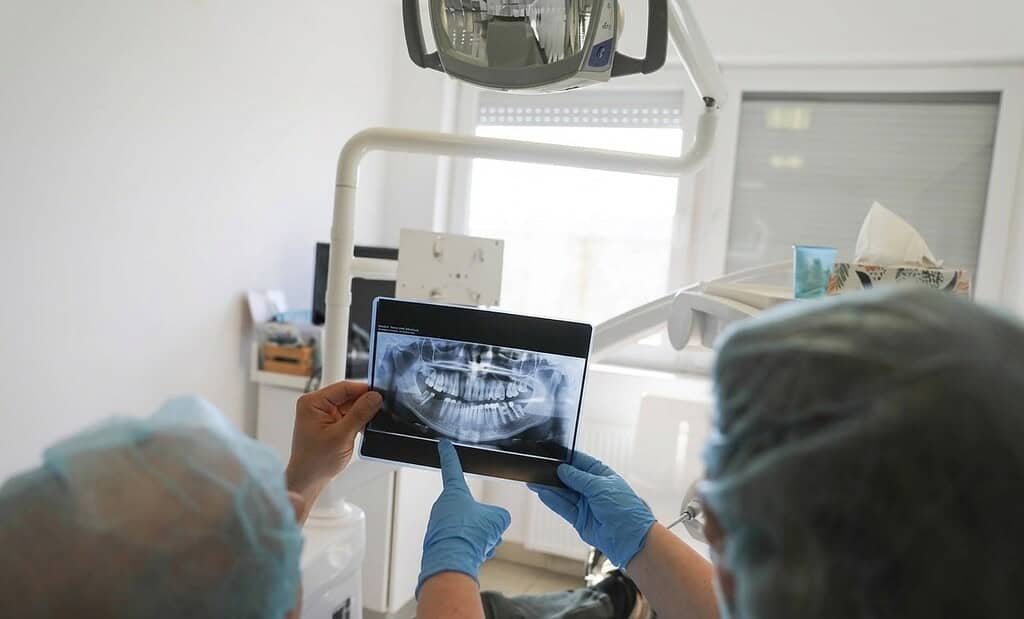
You can request it free of charge, even remotely: send your X-rays and our team will reply with a preliminary, no-obligation assessment.
Frequently asked questions
I'm 80 years old. Am I too old for implants?
Age alone is not an exclusionary criterion. We have 80-year-old patients who have completed the process with excellent results. What matters is general health, bone density, and the absence of unmanaged conditions. A clinical assessment is the only way to know for sure.
I'm taking medication for osteoporosis. Is that a problem?
It depends on the type of medication and the length of treatment. Low-dose oral bisphosphonates are generally less problematic than high-dose intravenous ones. It's one of the first things we assess — and in many cases, we find a solution. Always bring a complete list of the medications you are taking.
My father has diabetes. Can he have implants?
If diabetes is well controlled, in most cases yes. Uncontrolled diabetes increases the risk of infection and slows healing, but a diabetic patient with stable readings is not automatically excluded. We assess it on a case-by-case basis.
Is the procedure safe for an elderly patient with heart problems?
The procedure is carried out under local anaesthetic, not general. For most stable heart conditions, it does not represent a significant risk. In some cases, we coordinate with the patient's cardiologist before proceeding. Patient safety is always the priority.
How long is the post-operative recovery period?
In elderly patients, recovery may be slightly longer compared to younger patients, but it remains manageable. The first few days require rest and a soft diet. After a week, most patients resume normal activities. We will provide you with precise instructions for each stage.
Can I bring a family member with me to Tirana?
Absolutely, and it's actually recommended for elderly patients. The family member can participate in all clinical explanations and have a direct point of contact with our team during their stay.