A full dental restoration in Albania can be carried out using crowns, veneers, bridges, dental implants, or full-mouth rehabilitation. The treatment option and duration depend on the condition of the teeth, bone, and gums, so each patient needs a personalized plan. Here is everything you need to know.

What does it mean to completely restore your teeth?
Completely restoring your teeth does not necessarily mean extracting all the teeth and replacing them with implants. In many cases, some of the natural teeth can be treated and preserved.
The term includes various treatments aimed at restoring chewing, speech, oral health, and the appearance of the smile. It may mean restoring some damaged teeth or rehabilitating the entire upper arch, lower arch, or both.
A comprehensive dental treatment plan must be based on diagnosis and not only on the aesthetic result desired by the patient. Preserving healthy teeth should always be considered before recommending extractions or implants.
What are the options for getting your teeth redone in Albania?
The most suitable solution depends on the number of missing teeth, the extent of damage to the remaining teeth, the occlusion, and the amount of available jawbone.
When the roots are healthy, the teeth can be restored with fillings, root canal treatment, dental crowns, or bridges. The goal is to preserve as much of the natural structure as possible and restore the tooth’s function.
Dental veneers can be used when the main issue concerns the color, shape, size, or position of the front teeth. They are not the right solution for every patient and do not replace treatment for active gum or root problems.
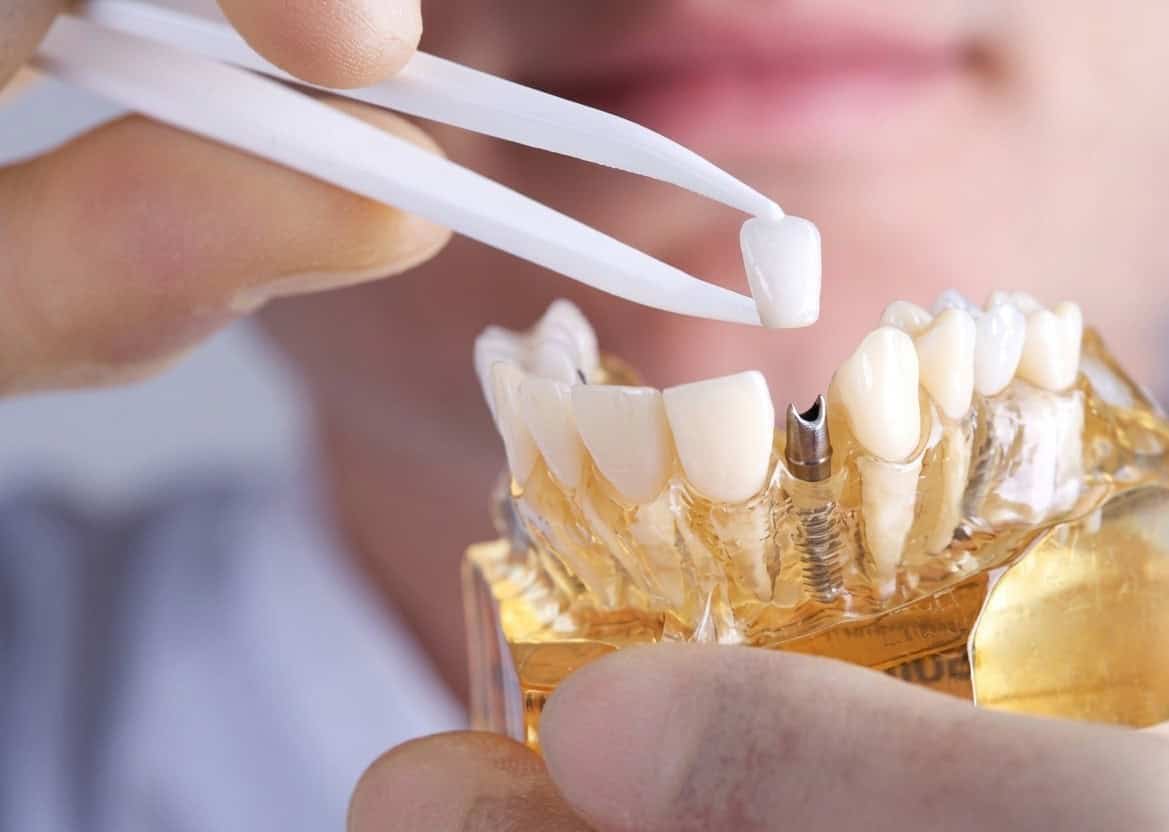
Dental implants are used to replace one or more missing teeth. A single crown, a bridge, or a more extensive fixed prosthesis can be placed on an implant.
When the patient has lost most or all of the teeth in one arch, a full implant-supported rehabilitation may be considered. The number and position of the implants are determined based on the anatomy of the jaw, bone quality, and the type of occlusion.
How is the most appropriate treatment determined?
The first step to getting your teeth redone in Albania is a comprehensive dental examination. Smile photographs alone are not enough to determine which teeth can be preserved and where implants can be placed.
The dentist must assess the teeth, roots, gums, occlusion, and jawbone. Depending on the case, a panoramic X-ray, a three-dimensional scan, and clinical photographs may be required.
The patient’s medical history must also be taken into account. Chronic illnesses, medications being taken, smoking, previous gum problems, and the way oral hygiene is maintained can all affect treatment planning.
After the examination, a treatment plan is developed outlining the various stages of care. The patient should understand which teeth will be preserved, which require treatment, where implants may be placed, and when the final teeth can be completed.
How long does full dental reconstruction take?
The duration can range from a few appointments to several months. There is no single timeframe that applies to all patients, because a rehabilitation with crowns on natural teeth does not follow the same course as implant treatment.
The initial condition of the mouth is the main determining factor. Infections, gum disease, lack of bone, and the need for extractions may require additional stages before the final restorations can be placed.

When natural teeth can be preserved
When the teeth have stable roots and good bone support, treatment may include a professional cleaning, root canal treatments, dental build-ups, and the placement of crowns.
In these cases, treatment can proceed more quickly than in a rehabilitation that requires surgery. However, the teeth and gums must be healthy before the final crowns or bridges are placed.
Temporary crowns may be used while the final restorations are being prepared. These protect the teeth and allow the dentist to assess the shape, occlusion, and appearance of the smile.
When extractions and dental implants are needed
If some teeth cannot be preserved, they may be extracted before or during implant placement. The timing of implant placement depends on the presence of infection, the condition of the bone, and the stability that can be achieved.
In some cases, the implant can be placed immediately after tooth extraction. In other cases, the area is left to heal before implant placement.
According to implantology protocols, implant placement after extraction may be scheduled after the soft tissues have healed or after a longer phase of partial bone healing. The timing is chosen based on the clinical conditions and should not be the same for every patient.
How long does it take for the implant to integrate with the bone?
After placement, the implant needs time to integrate with the jawbone. This process is called osseointegration and creates the stable foundation on which the final tooth will be placed.
The gums generally heal more quickly than the bone. Initial gum healing may occur within one or two weeks, while integration of the implant with the bone may take approximately two to six months.
The duration may vary depending on the area of the mouth, bone density, the number of implants, and the stability achieved during the procedure. Therefore, the fact that the patient no longer feels pain does not necessarily mean that the implant is ready for the final restoration.
Is it possible to place temporary teeth right away?
Yes, in selected cases it is possible to place temporary teeth on the implants immediately or within the first few days. This procedure is known as immediate loading or immediate restoration.
According to the ITI clinical definitions, immediate restoration involves placing a prosthesis on the implants within the first week. This protocol requires suitable conditions and sufficient implant stability.
The teeth placed at this stage are generally temporary. They are designed to protect the implants, preserve the appearance of the smile, and allow the patient to go through the healing phase without being left without teeth.
Temporary teeth should not be confused with the final restoration. The material, shape, and occlusion can be adjusted after the gums and bone have completed the main phase of healing.
Not all patients can receive fixed teeth immediately. If implant stability is not sufficient, if the bone is weak, or if other risk factors are present, a different temporary rehabilitation solution may be recommended.
A bone graft is necessary when there is a bone defect or loss that needs to be repaired. This can happen for a variety of reasons, including: * **Trauma:** Fractures or injuries that result in significant bone loss. * **Infection:** Bone infections (osteomyelitis) can destroy bone tissue, requiring replacement. * **Tumours:** Removal of bone tumours can leave a defect that needs grafting. * **Congenital defects:** Birth defects that result in missing or malformed bone segments. * **Degenerative diseases:** Conditions like osteoporosis can weaken bones, sometimes leading to fractures that require grafting. * **Dental procedures:** In dentistry, bone grafts are often used in procedures like dental implants to augment the jawbone, or to repair bone loss due to gum disease or tooth extraction. * **Spinal fusion:** In spinal surgery, bone grafts are used to fuse vertebrae together, stabilising the spine.
A bone graft may be necessary when the jaw does not have sufficient volume to support the implant in the planned position. This may occur after tooth loss, previous infections, or periodontal disease.
In some cases, the graft and the implant can be performed during the same procedure. In other cases, the graft must heal before the implant can be placed.
When the graft is performed as a separate phase, healing may take about three to six months before implant treatment can continue. The exact time depends on the size and position of the graft.
The need for a graft cannot be determined simply by looking in the mirror at the spaces left by missing teeth. Three-dimensional bone assessment helps measure the height, width, and anatomy of the area where the implant is planned.
How many visits are needed for dental treatment in Albania?
The number of visits depends on the type of treatment. Treatment with crowns or veneers may be organized differently from full-mouth rehabilitation involving extractions, bone grafting, and implants.
Patients traveling from abroad should receive a clear plan before departure. The initial documentation may include a panoramic X-ray, photographs of the teeth, information about existing medical conditions, and a list of medications being taken.
A remote assessment can help develop a preliminary plan, but the final decision is made after the clinical examination. The X-ray can show the bone structures, but it does not replace the assessment of the gums, tooth mobility, and occlusion.
When implants are used, one visit may be required for the surgical phase and another visit after healing to place the final teeth. In other cases, treatment may involve a greater number of phases.
The patient should not book the return trip based solely on a general timeline found online. The length of stay should be confirmed after the dentist has assessed the specific case.

What can prolong treatment?
The presence of active infections can change the order of treatment. Before long-term restorations are placed, it may be necessary to treat the gums, infected roots, or teeth with a poor prognosis.
Insufficient bone may require a bone graft or other regenerative procedures. Very strong occlusion, teeth grinding, and uneven load distribution must also be taken into account when designing the new teeth.
Smoking and poor oral hygiene can negatively affect healing and the health of the tissues around the implants. The patient must accurately inform the dentist about any habits, medical conditions, and medications that may be relevant to the treatment.
A change to the plan during treatment does not always mean that something has gone wrong. Sometimes, the true condition of a tooth or the bone becomes fully evident only during the clinical phases.
Why should the final teeth not be placed too soon?
The goal of treatment is not simply to place white teeth, but to create stable occlusion and a shape that can be properly cleaned.
After implant placement, the gums may change during healing. Temporary teeth allow the dental team to assess aesthetics, speech, chewing, and the contacts between the teeth.
If the final restoration is placed before the tissues have stabilized, it may be more difficult to achieve an optimal fit. For this reason, speed of results should not take priority over healing and careful planning.
How to choose a clinic for getting your teeth done in Albania?
A dental clinic should explain the diagnosis, the alternatives, and the sequence of treatment. The patient should understand why a specific procedure is being recommended and which parts of the plan may change after the examination.
It is advisable to ask for information about the materials, the type of implants, the planning method, and the post-treatment care. It is also important to know who will perform the surgical phase and the prosthetic phase.
Promises of the same treatment and the same timeline for every patient should be evaluated carefully. A reliable treatment plan is personalized and takes into account oral health, bone, gums, occlusion, and the patient’s expectations.
How are the new teeth maintained after treatment?
Implants and artificial teeth also require daily cleaning. Bacterial plaque can accumulate around implants, under bridges, and in the areas where the restoration meets the gums.
The cleaning method varies depending on the type of restoration. The dentist may recommend interdental brushes, a specific type of floss, or other tools for cleaning under fixed restorations.
Regular check-ups are important to assess the gums, occlusion, and the condition of the implants. Good oral hygiene and professional maintenance help prevent problems around implants.

Getting your teeth done at Hygeia Dent
At Hygeia Dent, the process begins with an assessment of the condition of the teeth, gums, and jawbone. A treatment plan is then prepared based on the patient’s functional and aesthetic needs.
Patients interested in a full dental restoration in Albania can send their X-ray and information about their condition in advance. The final treatment plan is confirmed after an in-person visit to the clinic.
The goal is to identify the solution that preserves healthy structures, restores oral function, and provides a natural, stable result.
Frequently asked questions
Is it possible to treat only the upper teeth?
Yes, it is possible to treat only the upper arch, but the way it comes into contact with the lower teeth must also be checked. A significant change in the shape or height of the upper teeth can affect the bite.
Is it possible to restore the mouth without implants?
Yes. When the tooth roots are viable, rehabilitation can be carried out with crowns and bridges supported by the natural teeth. In other cases, removable dentures may be used.
Can I get implants if I take anticoagulant medication?
Treatment may be possible, but it must be planned in collaboration with the dentist and the physician overseeing the patient’s care. Medications should not be stopped or changed without medical advice.
Is it possible to place implants after many years without teeth?
Yes, but prolonged tooth loss may be associated with bone loss. A scan is needed to determine whether implants can be placed directly or whether additional bone preparation is required.
Should I bring my old X-rays and dental records with me?
Yes. X-rays, scans, previous clinical records, and information about existing implants or crowns can help the dentist understand your treatment history. However, new tests may be needed if the previous documentation does not show your current condition.